Many companies face a common budgeting dilemma: they spend months preparing the budget each year, only to drift off track during execution and end up with significant variances between the budgeted and actual results at year-end. The root cause often lies not in the preparation techniques, but in structural flaws within the budgeting system itself. For budgets to be effective, organizational support, process design, and performance management mechanisms must work together.
Organizational Support: Budgeting is not just the finance department's responsibility.
Most companies treat budgeting as a finance-only function, with business units passively providing data. This disconnect leads to budgets that don't align with operations: finance lacks insight into business logic, resulting in numbers that are hard to execute; while business units, excluded from the process, feel no ownership of the targets.
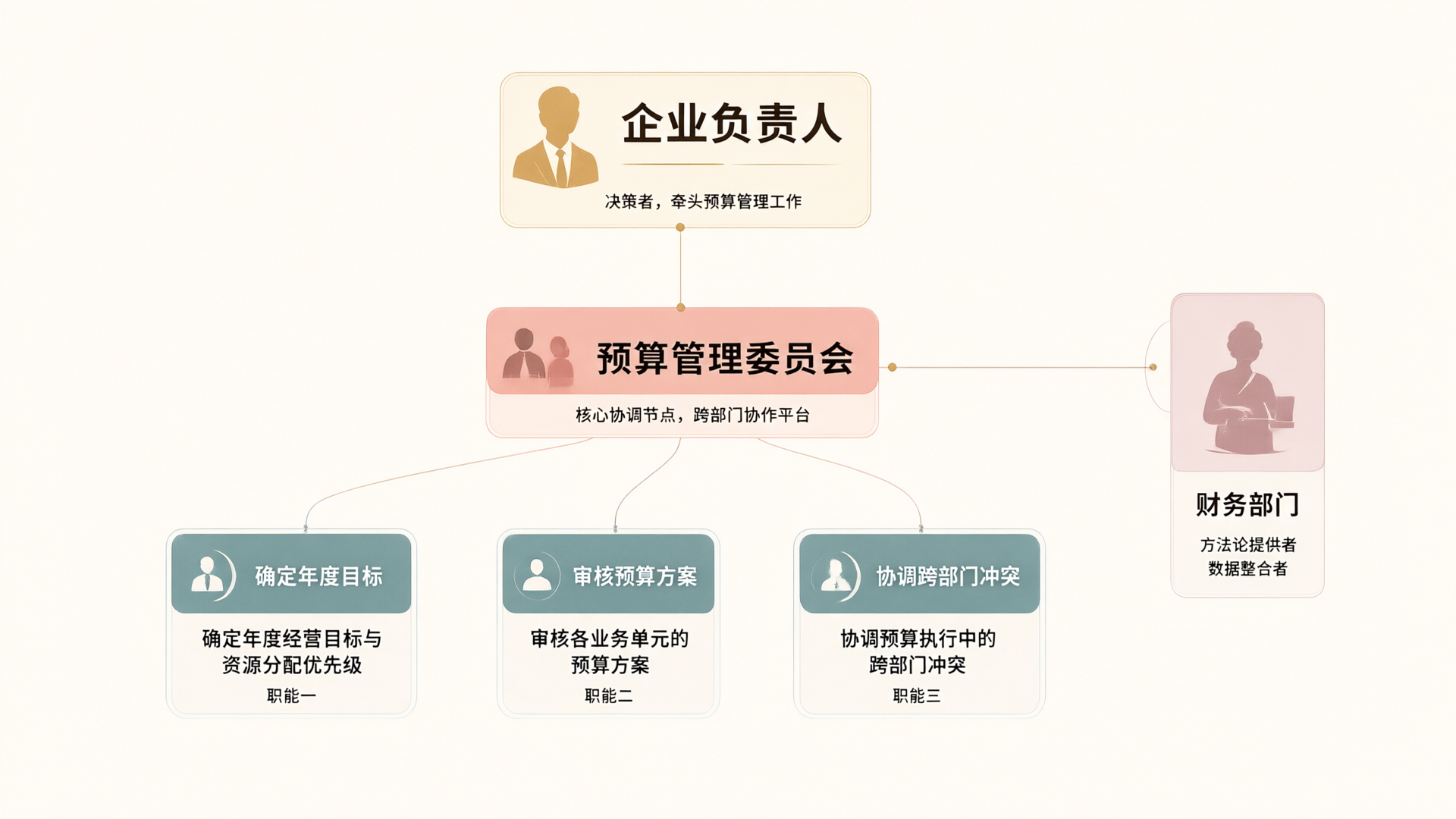
A robust budget management system requires a cross-functional Budget Committee led by the executive sponsor and comprising heads of all business units. The committee has three core responsibilities: setting annual operating goals and resource allocation priorities, reviewing budget proposals from each business unit, and resolving cross-departmental conflicts during execution. The finance function serves as the methodology provider and data integrator, not as the decision-maker.
In our management accounting consulting practice at Hongzhu, we've identified a key pattern: companies with successful budget implementation share one common trait—their business leaders actively participate in the entire budgeting process, not just sign off during final approval. This involvement goes beyond merely attending meetings; it requires business leaders to explain and commit to every budget assumption.
Process Design: Decomposing Strategy into Execution
The essence of budgeting is the digital expression of strategy. If a company's strategic goals cannot be broken down into quantifiable annual operating plans, the budgeting process loses its starting point.
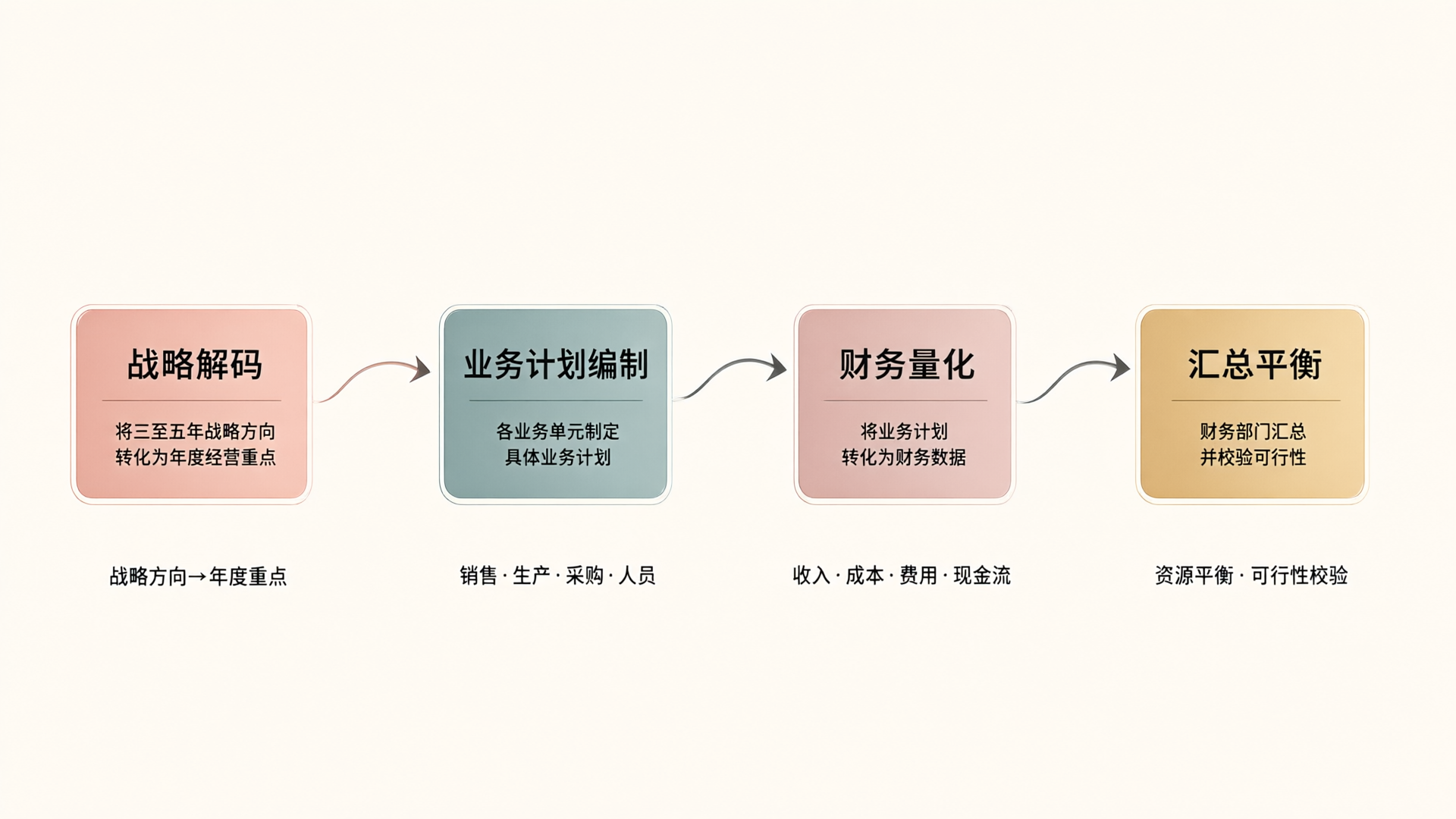
The complete budgeting process consists of four stages. In the Strategy Decoding phase, a three-to-five-year strategic direction is translated into annual operational priorities, clarifying revenue growth drivers, cost control directions, and resource allocation priorities. During the Business Plan Formulation phase, each business unit develops specific business plans based on these priorities, including sales targets, production schedules, procurement strategies, and staffing plans. The Financial Quantification phase converts business plans into financial data, generating revenue budgets, cost budgets, expense budgets, and cash flow budgets. Finally, in the Consolidation and Balancing phase, the finance department aggregates budgets from all units, performs resource balancing and feasibility validation, and submits them to the Budget Committee for approval.
The key to this process is prioritizing business planning before financial quantification. Budgets must reflect actual operational logic by first defining business actions, then calculating the numbers. If you start with financial metrics and work backward to determine business activities, the budget becomes a mere number game.
Assessment Mechanism: Link Budgets to Business Outcomes
Once budgeting is complete, without effective execution monitoring and evaluation mechanisms, the budget will gradually be ignored. The evaluation mechanism must address two key issues: how to measure budget performance and how to link results to incentives.
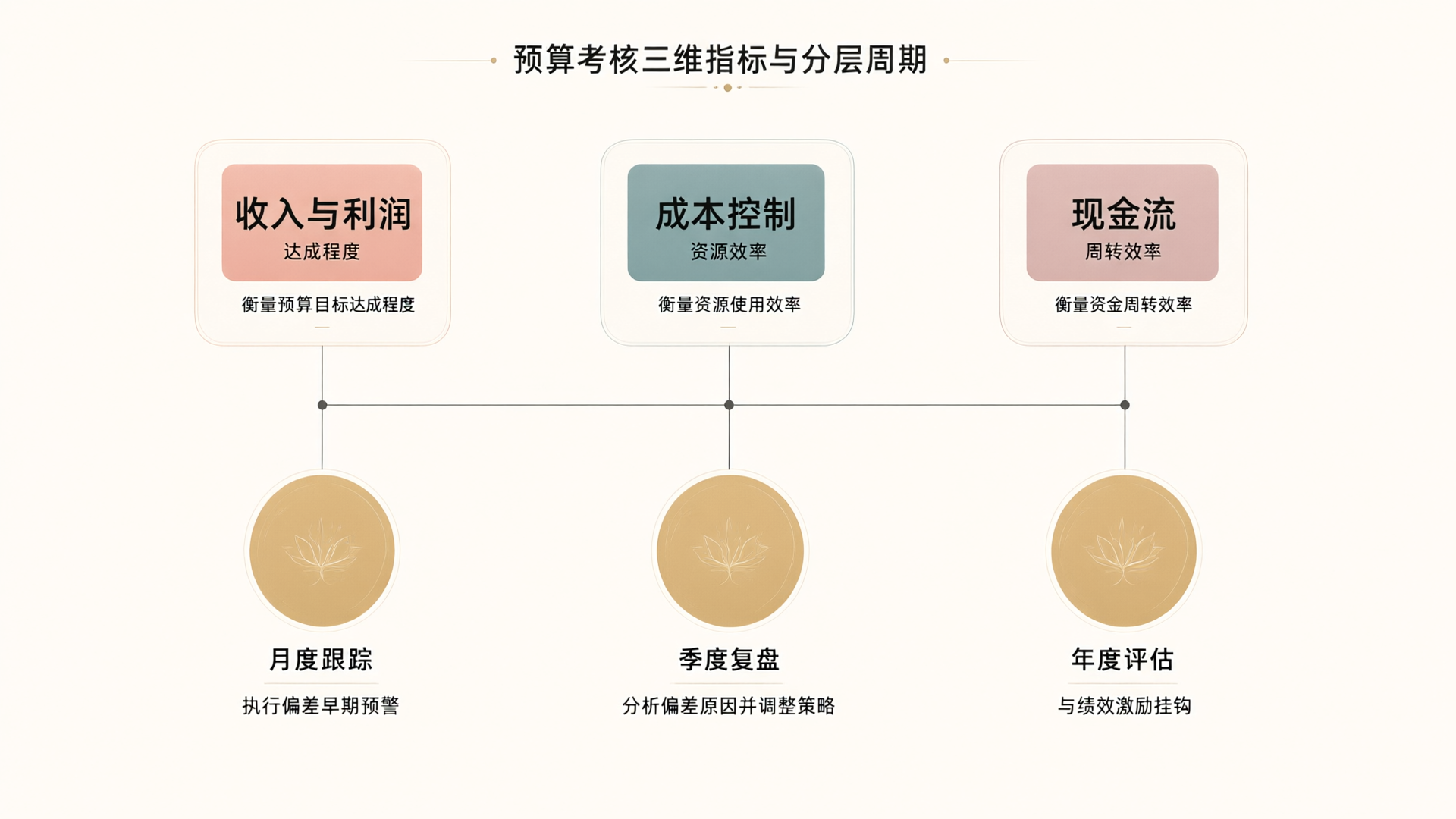
Budget assessment typically relies on three core metrics. Revenue and profit metrics measure the achievement of budget targets. Cost control metrics evaluate resource efficiency, such as unit product cost and expense ratios. Cash flow metrics assess capital turnover, including days sales outstanding (DSO) and days inventory outstanding (DIO). Among our enterprise clients using Hongzhu Management Accounting services, average cost reduction and efficiency gains reached 15%, driven largely by a budget assessment mechanism that breaks down cost control objectives into specific owners and business processes.
The assessment cycle must align with business rhythms. Monthly tracking provides early warnings for execution deviations, quarterly reviews analyze the root causes of deviations and adjust strategies, and annual evaluations are tied to performance incentives. This layered assessment model ensures continuous budget execution while avoiding frequent target adjustments due to short-term fluctuations.
Digital Enablement: From Manual Spreadsheets to Systematic Management
Traditional budgeting relies on manual Excel work, leading to low efficiency, poor collaboration, and version chaos. Digital budgeting tools address three core pain points: data consistency during multi-user collaboration, real-time comparison between budgeted and actual figures, and full traceability of budget adjustments.
For small and medium-sized enterprises, selecting digital tools requires balancing feature completeness with implementation complexity. Start with a lightweight budgeting module integrated with your existing financial system to enable core functions like budget creation, execution monitoring, and variance analysis. As management maturity grows, progressively expand to advanced capabilities such as rolling forecasts and scenario simulations.
Digitization is not the goal—it's a means. The value of tools lies in standardizing budget management processes, increasing data transparency, and enabling timely decision-making. If an enterprise's budget process is flawed, digital tools will only accelerate those errors.
Implementation Path
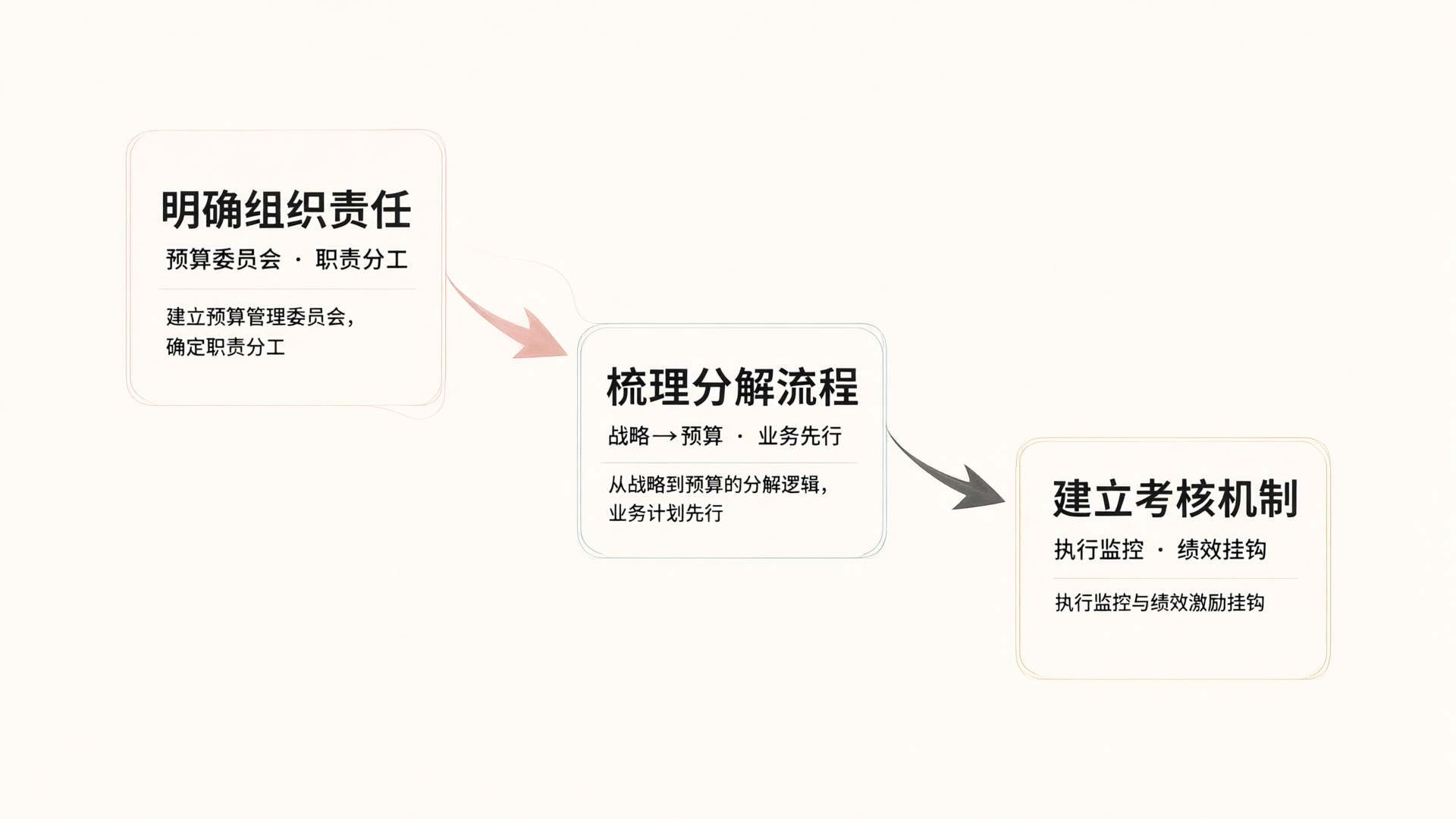
Building a comprehensive budget management system is not an overnight project. For enterprises that have not yet established such a system, we recommend a three-step approach: first, define organizational responsibilities for budget management; second, map the process of cascading strategy into budgets; and third, implement execution monitoring and performance evaluation mechanisms. Each step must be tailored to your company's specific business characteristics and management foundation, rather than simply copying industry best practices.
With over 10 years of management accounting practice, Hongzhu has consistently helped small and medium-sized enterprises build actionable budget management systems. The core of budget management lies not in refining preparation techniques, but in making budgets a true bridge between strategy and execution—enabling businesses to control operational risks, protect profits, and drive performance growth.