SMEs' operational risks rarely explode overnight. A single overdue receivable, a mixed personal-business expense, or a quarter of underperforming collections—these early warning signs are often ignored or absorbed by business owners. By the time cash flow tightens and tax notices arrive, manageable issues have escalated into emergencies.
Through serving over 50 small and medium-sized enterprises, Hongzhu Management Accounting has identified a common pattern in financial and tax risks: they all exhibit detectable warning signs before escalating. Based on this insight, we distilled the risk identification logic honed over 10 years of industry experience into a free financial and tax risk assessment tool featuring 20 professional diagnostic questions, available to business owners and finance leaders at no cost.
Design logic: Why 20 questions?
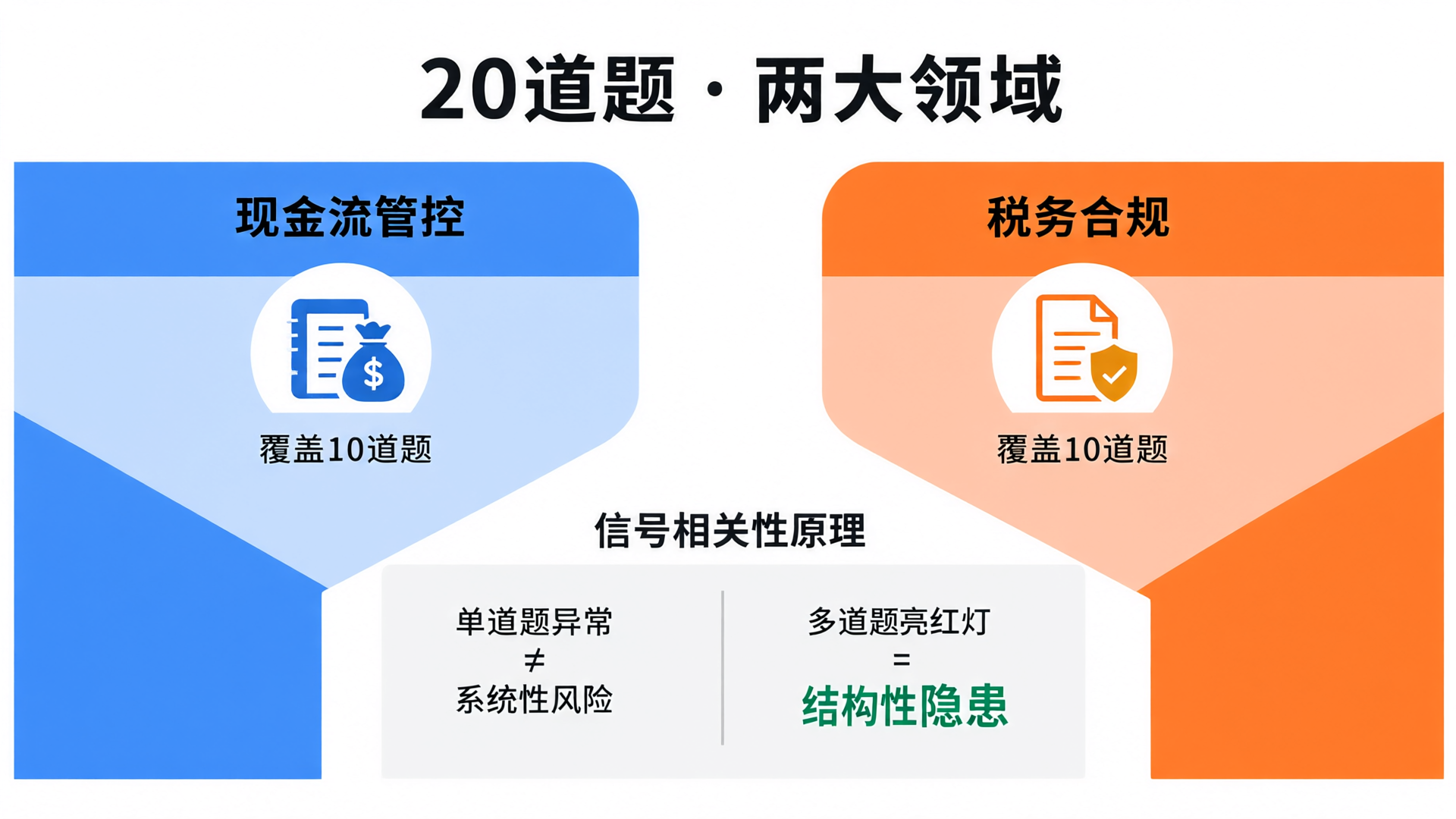
The 20 questions are carefully designed. Based on years of consulting with small and medium-sized enterprises, we identified their most frequent financial and tax risk scenarios and converted each into one or two true/false or multiple-choice questions. These cover cash flow management and tax compliance, with every question reflecting a real-world warning sign.
The assessment is built on the principle of "signal correlation": a single red flag may not indicate systemic risk, but multiple concurrent warnings suggest structural operational issues rather than isolated incidents. The tool generates a risk-level evaluation based on responses to help users determine whether the situation can be managed internally or requires professional intervention.
Early Warning Signs of Cash Flow Breakdown: What to Watch For
Cash flow is the lifeline of small and medium-sized enterprises. In 20 questions, those related to cash flow make up a significant portion. Here are some typical risk signals:
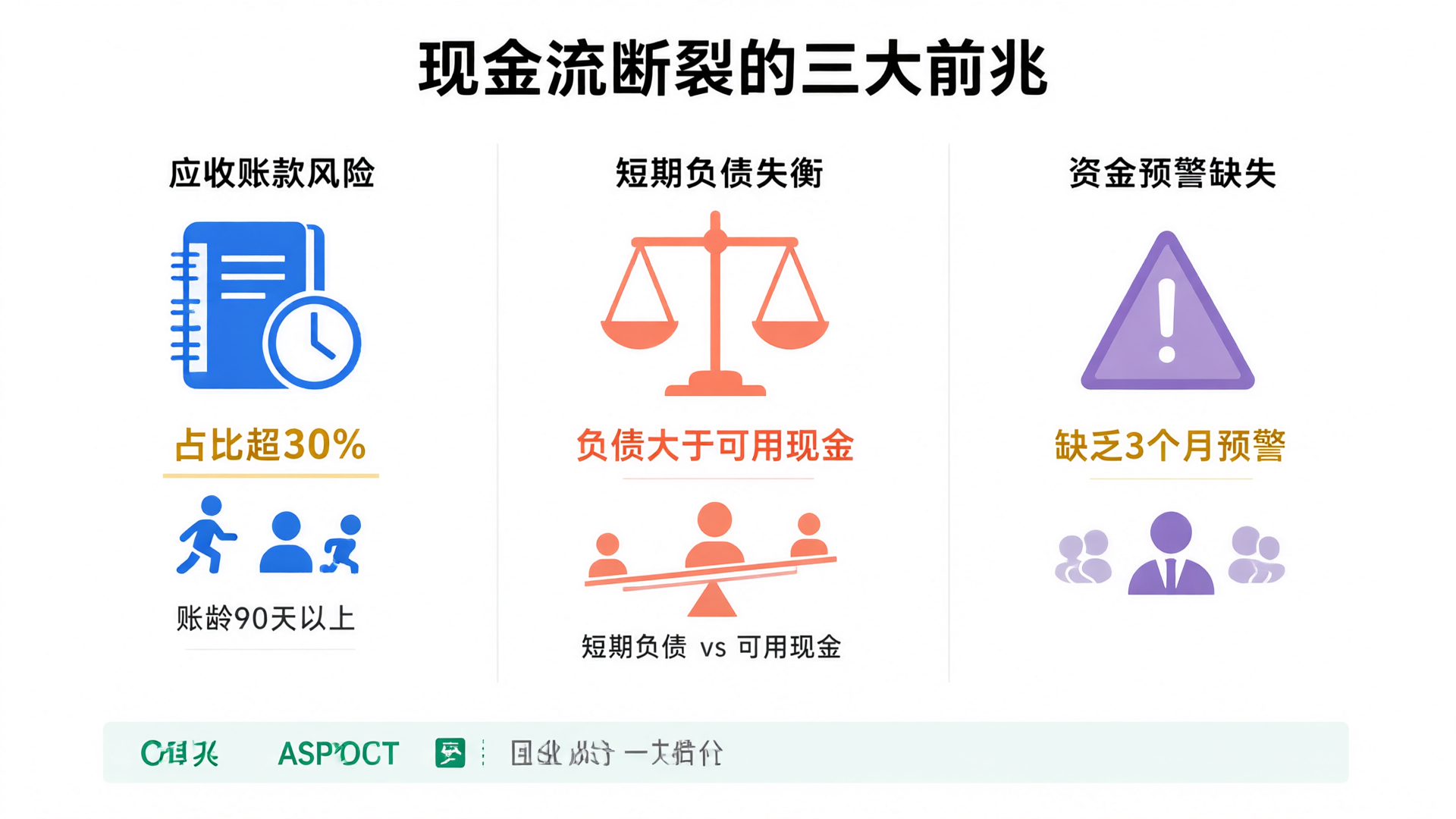
Accounts receivable exceeds 30% of revenue, with aging concentrated over 90 days. This metric reflects the company's collection capability. Even if reported profits look strong, unrecovered cash is just paper wealth. In serving manufacturing clients, we've repeatedly seen companies with annual revenues exceeding $10 million unable to pay employee wages due to uncontrolled accounts receivable management.
An imbalance between short-term liabilities and available cash. When a company's debt due within 30 days exceeds its accessible cash, a liquidity crisis is inevitable.
Lacks a fund warning mechanism for periods exceeding 3 months. Without cash flow forecasting, businesses are essentially operating on intuition. By the time you realize funds are insufficient, it's often too late to adjust.
Missing payment status tracking. After completing payments, enterprises fail to promptly confirm "Payment Completed," leading to duplicate payments, delays, or lost payment receipts. In our client engagements, many SMEs have experienced duplicate payments for the same transaction or failed to obtain compliant receipts due to loose payment management. This directly impacts their ability to deduct costs and expenses from taxable income.
When these signals appear individually, business owners often tell themselves, "Things will get better next quarter." But our experience shows that if all four signals are present, the situation is unlikely to improve on its own.
Common Compliance Pitfalls: Overlooked Risk Zones
Tax compliance is another high-risk area. In the 20 questions, compliance-related issues are often more subtle because business owners may not even realize these practices carry risks.
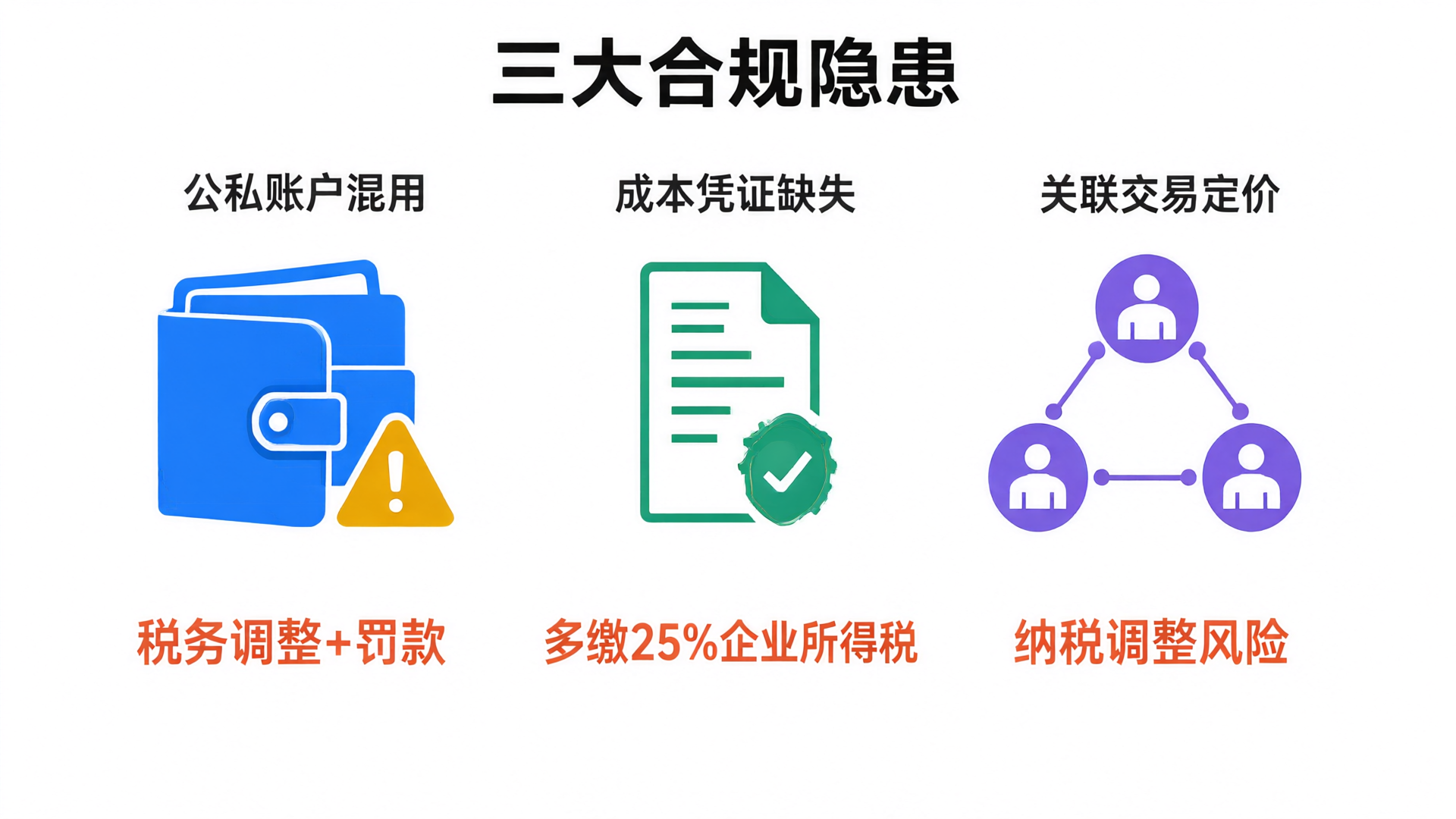
Mixing personal and business accounts is one of the most common compliance issues. When business owners use personal accounts to collect company payments or use corporate accounts for household expenses, these activities are now easily tracked after the Golden Tax System upgrade. If deemed tax evasion, companies face not only back taxes but also late fees and penalties.
Non-compliant documentation for cost and expense claims. Expenditures without invoices cannot be deducted for corporate income tax purposes, potentially causing the company to overpay up to 25% in corporate income tax on costs that should have been deductible.
Lack of reasonable basis for transfer pricing. If transaction prices between affiliated companies within a group deviate significantly from market prices, tax authorities may adjust taxable income. Such issues are common in large enterprise groups.
These compliance risks are often overlooked because small and medium-sized enterprises prioritize business growth, relegating financial compliance to the bottom of their priority list.
Typical Use Cases
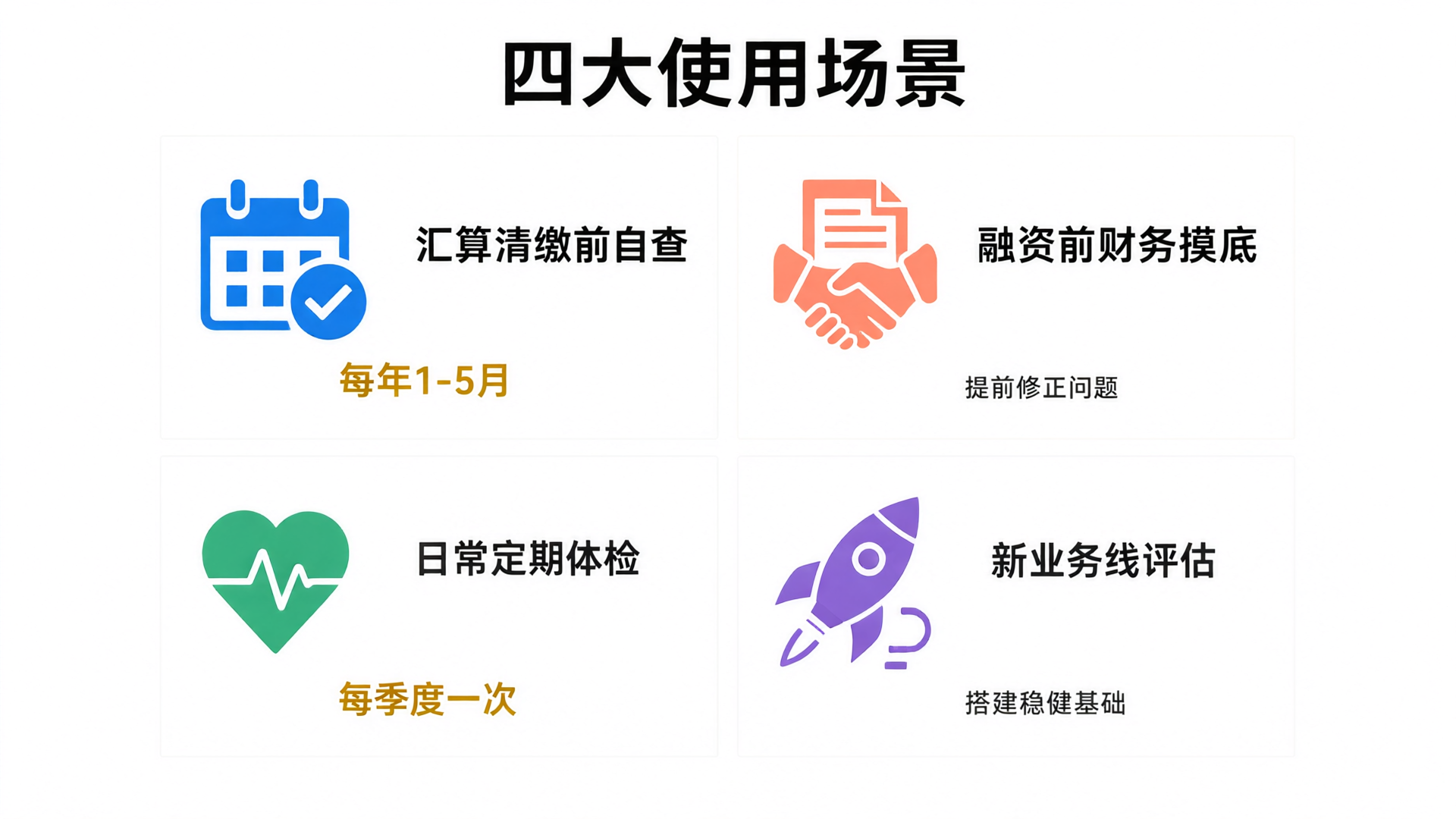
This tool is especially suitable for the following scenarios:
Self-assessment before the annual tax reconciliation. The corporate income tax filing period runs from 1 to 5 each year. Complete a full check with 20 questions beforehand to identify potential issues before filing and avoid reactive adjustments after submission.
Pre-funding or pre-investment financial health check. When seeking external capital, investors typically conduct financial due diligence. Use tools to identify and fix issues beforehand for a smoother funding process.
Regular health checks for daily operations. We recommend using the tool quarterly to track trends in risk indicators. The key to tax and financial risk management is "early detection, frequent review"—just like a physical exam, frequency matters more than depth per session.
Risk assessment before launching a new business line. When entering a new business area, the tax and financial compliance framework may need adjustment. Proactively assessing existing business risks helps establish a more robust financial foundation for the new venture.
How to use this tool
Using the tool is simple: Go to the "Management Tools" section on the Hongzhu Management Accounting website, navigate to the Tax and Financial Risk Detection page, and answer the questions one by one. The entire process takes approximately 5 to 10 minutes. Each question includes clear instructions and options, so no professional accounting knowledge is required. Upon completion, the system will instantly generate your risk assessment report and corresponding risk level.
Note that this tool is designed for "risk screening," not "risk diagnosis." Its purpose is to help business owners identify areas requiring attention, not to replace professional tax and financial consulting services. If the assessment reveals medium-to-high risk items, we recommend seeking in-depth analysis from a qualified professional team.
The core of tax and financial risk management is early intervention. 20 questions, taking 5 to 10 minutes, deliver an initial assessment of your company's tax and financial health. For small and medium-sized enterprises with limited management scope and lean finance teams, this low-cost self-check approach is the first step toward building a risk management mindset.