
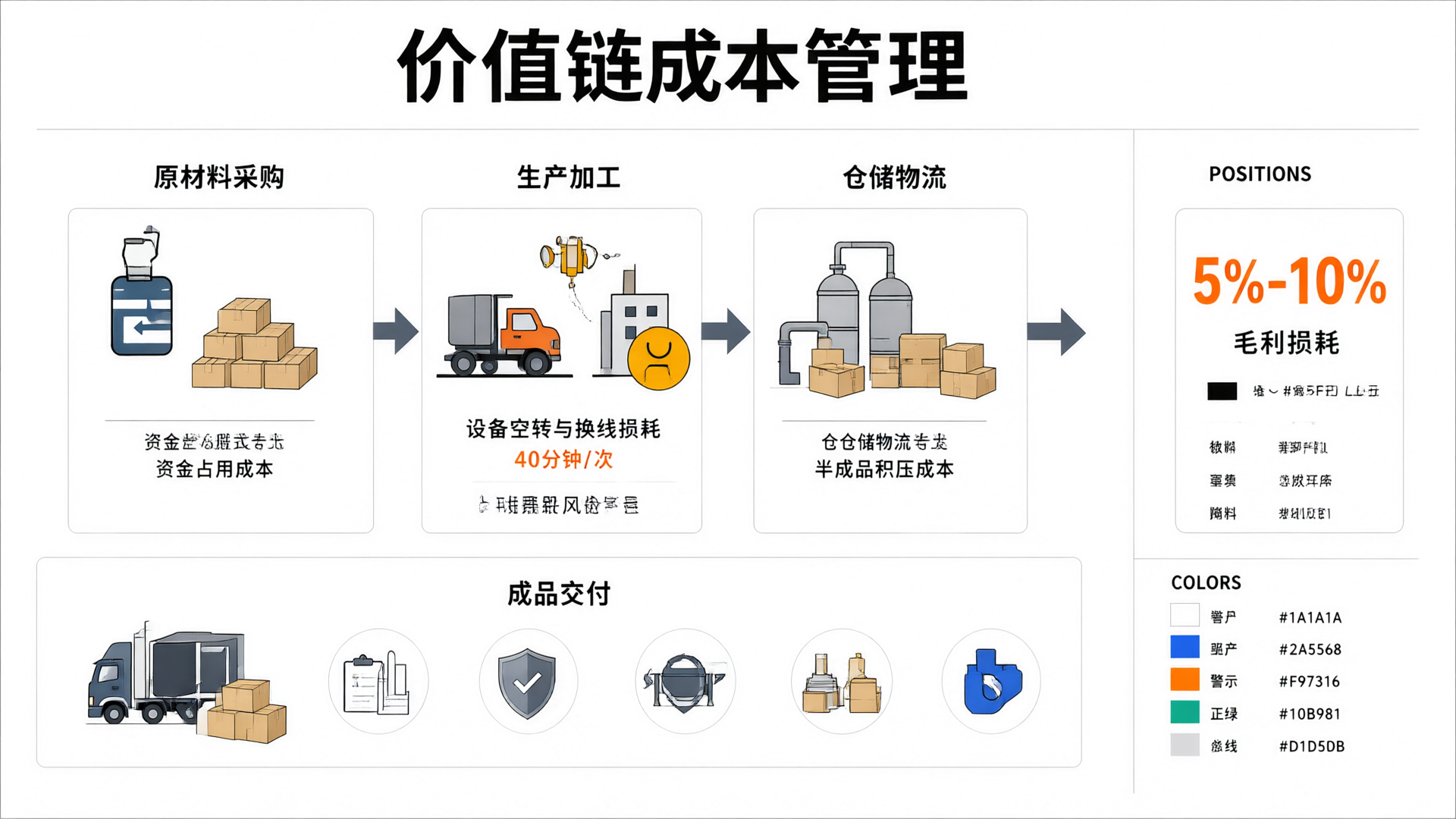
Cost control in manufacturing often remains stuck at "cutting budgets and squeezing supplier prices." While this may show short-term improvements on financial statements, it fails to address the real sources of profit leakage. Through our work with manufacturing clients, we've identified significant hidden waste in production processes. This waste doesn't appear as isolated anomalies in individual accounts but is scattered across multiple nodes of the value chain—interconnected and mutually amplifying.
Core logic of value chain cost management
Traditional cost accounting is based on the "materials, labor, and overhead" framework, focusing on direct costs for individual products. Value chain cost management takes a broader view: from raw material procurement, production processing, warehousing, and logistics to final delivery, every stage incurs costs and generates waste.
Hidden waste refers to inefficient behaviors that are difficult to identify in standard cost reports yet continuously drain resources. Examples include:
- Unreasonable production scheduling causes equipment idle time and changeover losses. Each mold change on an injection molding machine takes 40 minutes. With 6 changeovers per day, waiting time alone results in a loss of 4 hours of capacity.
- Working capital tied up in unfinished goods and warehouse space. WIP piled on the shop floor may appear to be "normal flow," but each extra day of停留 incurs additional financing costs.
- Hidden costs of quality rework. A drop in yield from 98% to 95% may seem small, but the labor, materials, and delivery delays required for rework often exceed the cost of raw materials themselves.
Individually, these inefficiencies may seem minor, but combined, they can erode 5%-10% of gross margin.
Three Typical Hidden Wastes in Production
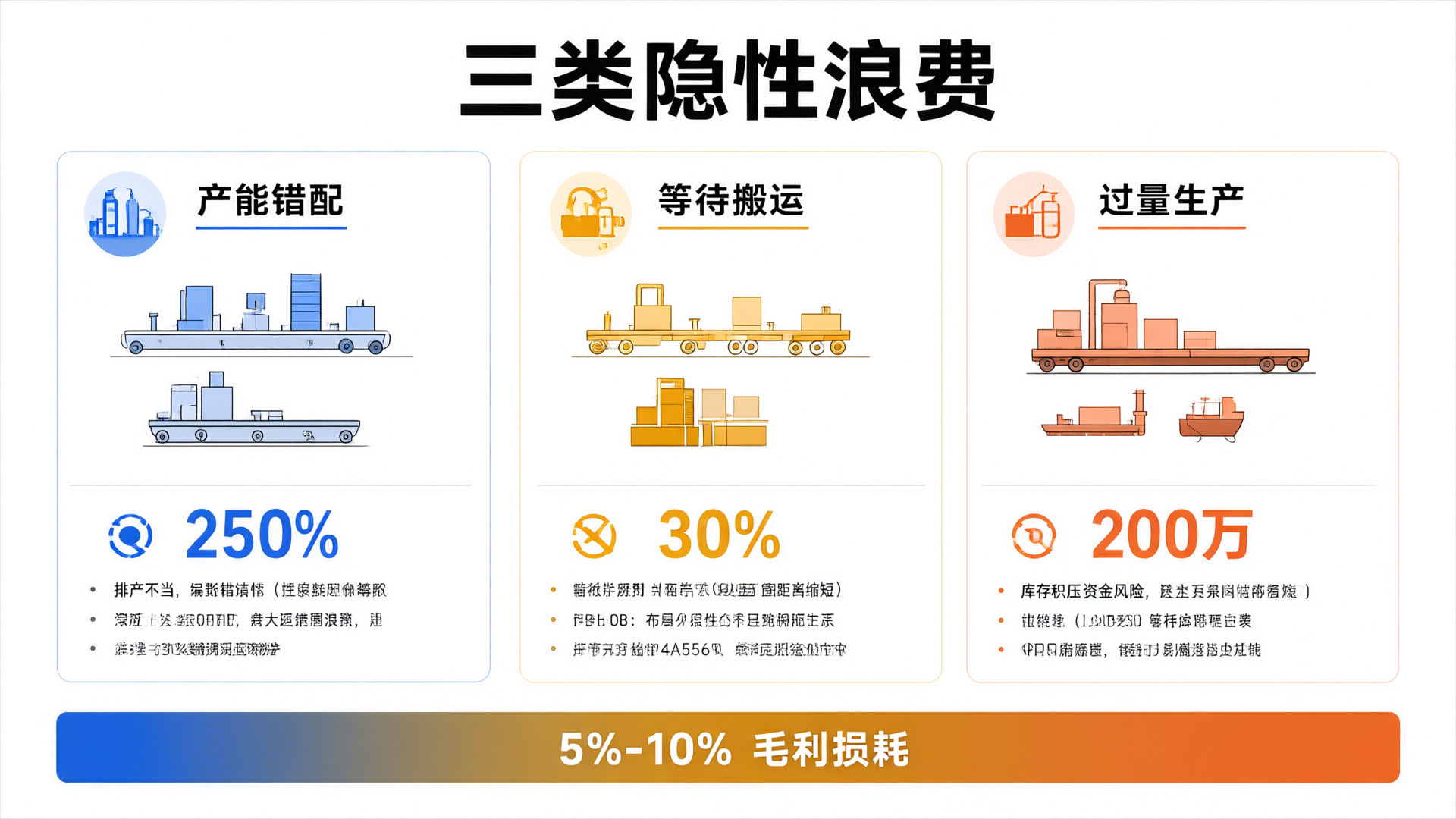
In our practical projects, we have categorized the hidden wastes in manufacturing production processes into three types.
The first type is capacity mismatch waste. Most factories operate multiple product lines, and different products consume equipment, labor, and time differently. When production scheduling prioritizes only order due dates without considering capacity constraints, high-margin products may be scheduled during low-efficiency periods, while low-margin products occupy prime capacity. This mismatch never appears in financial statements but directly reduces overall profitability.
The second category is waiting and transportation waste. Excessive material transport distances between production lines and prolonged wait times between processes are two of the "Seven Wastes" in Lean Manufacturing. A hardware processing plant once calculated that after reorganizing its workshop layout, material transport distance was reduced by 30%, and the production cycle per unit dropped from 3.2 days to 2.1 days. The resulting monthly capacity increase equaled the output of one additional machine.
The third type is overproduction waste. Producing beyond demand to spread fixed costs may appear to lower unit costs, but it actually leads to finished goods inventory buildup. Excess inventory ties up capital and exposes the company to risks of price depreciation and obsolescence. An electronics components manufacturer once overstocked; when market demand shifted, it ended up with nearly 200 million yuan in stagnant inventory—equivalent to 15% of its annual net profit.
Factory Optimal Production Plan Calculator: Implementation Guide
Identifying waste is just the first step; the key lies in determining the optimal production mix. This is where linear programming—a core management accounting technique—comes into play: it finds the product combination that maximizes profit under constraints such as capacity, labor hours, and raw materials.
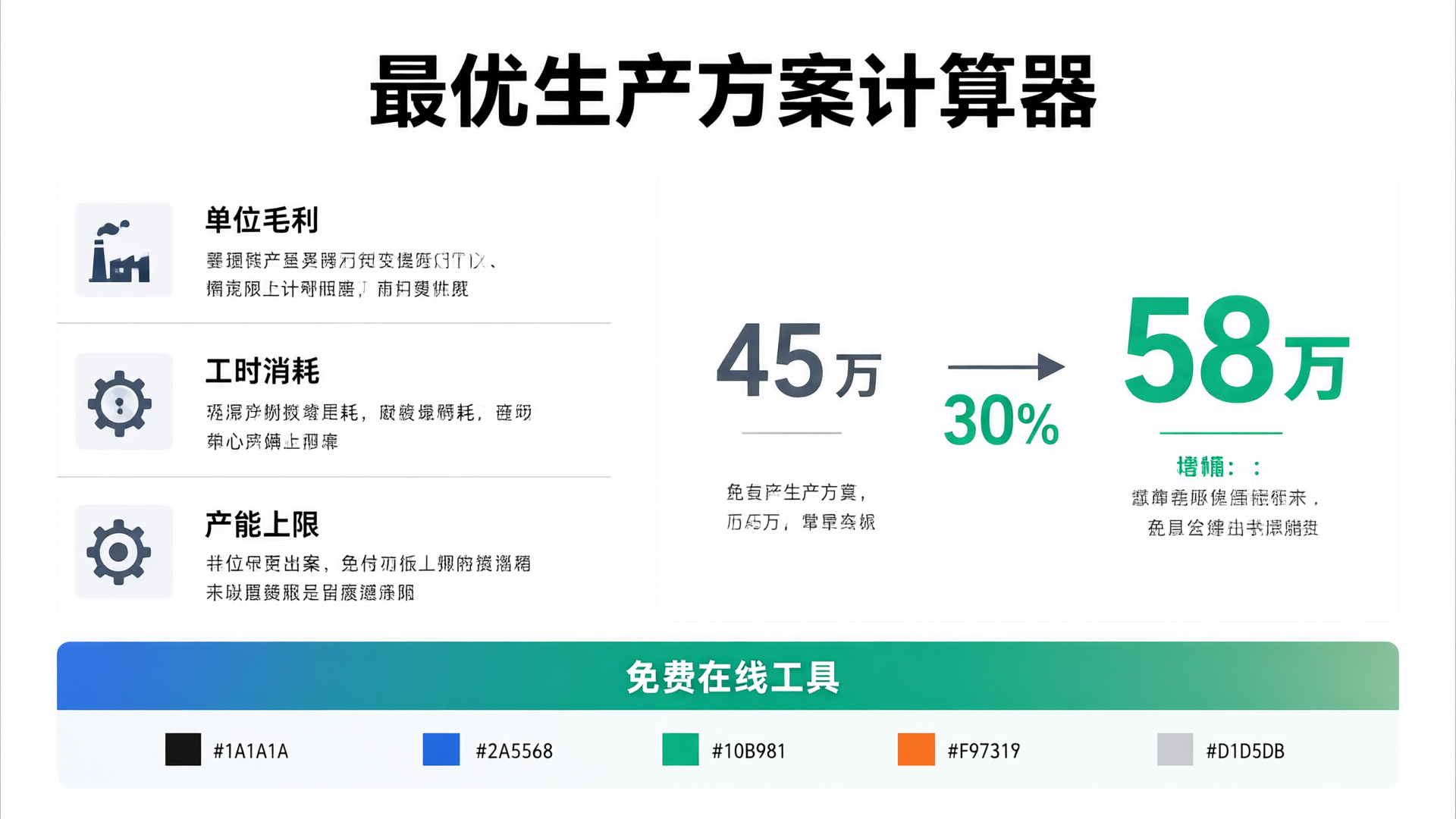
We've developed an optimal production solution calculator for small and medium-sized enterprises, turning this mathematical model into a practical tool. Users simply need to input the following information:
- Unit contribution margin for each product (selling price minus unit variable cost).
- Unit labor hours consumed per product across different equipment or processes.
- Maximum available capacity for each equipment or process.
The calculator automatically determines the optimal production mix and recommends output levels for each product based on these constraints. For a factory with 3 product lines and 2 core machines: scheduling by order sequence yields approximately ¥45 in monthly profit, while optimized scheduling increases it to ¥58, a rise of nearly 30%. This profit growth comes purely from optimizing the production mix—no additional capacity or price reductions are required.
This tool is easy to use and requires no background in operations research or linear programming. It translates professional management accounting methods into actionable tools, enabling business owners and finance leaders to make data-driven production decisions independently.
From Tools to Systems: A Roadmap for Implementing Cost Control
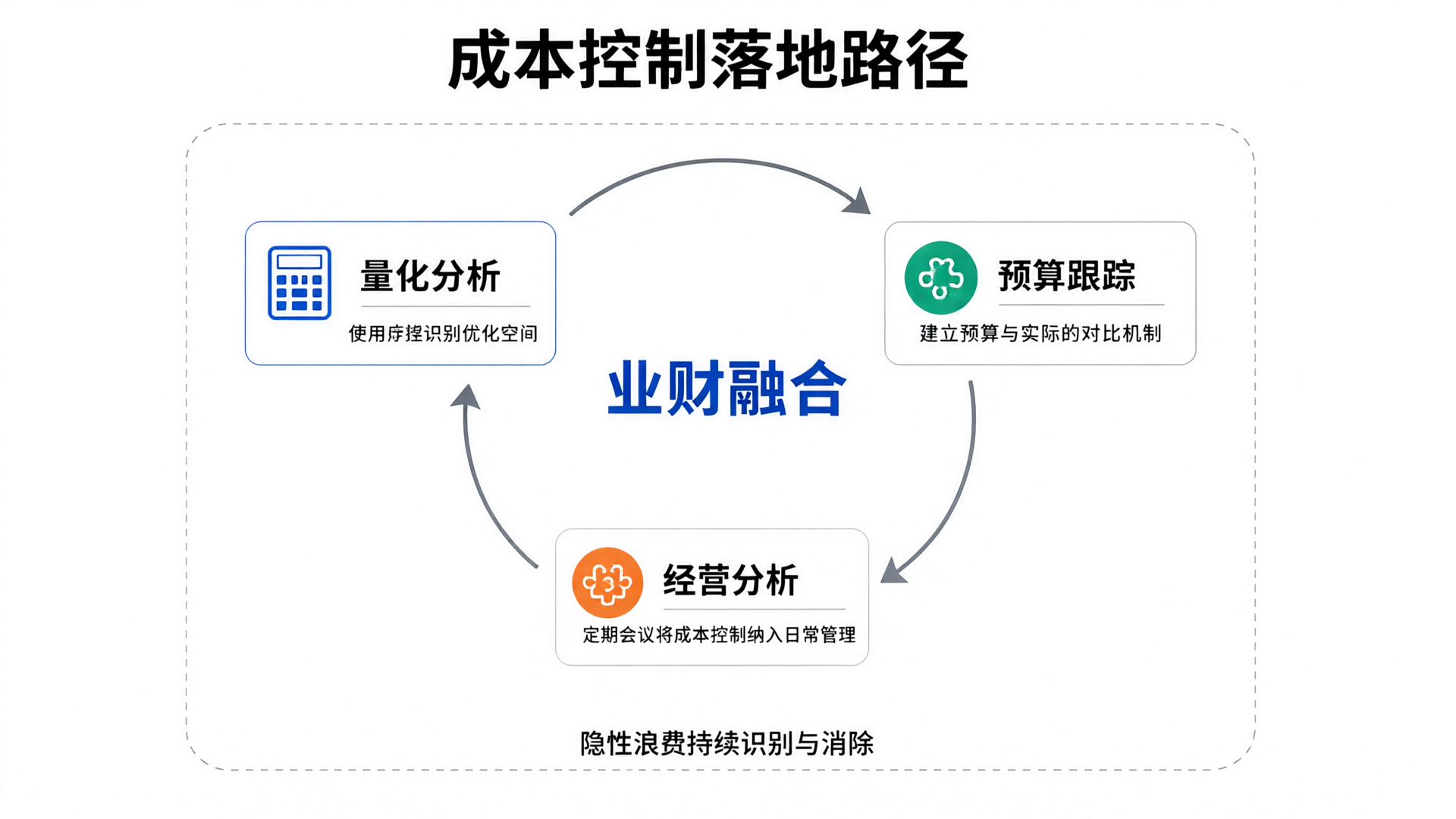
Calculators address the "what to produce" and "how much to produce" decisions, but a complete cost control cycle requires supporting management actions. Our standard approach in projects is: first, use tools for quantitative analysis to identify optimization opportunities; second, establish a budget-versus-actual tracking mechanism to ensure execution aligns with the optimization plan; and finally, incorporate cost control into daily operations through regular business review meetings.
The core of this methodology is business-finance integration: financial data serves not as a post-event accounting record, but as a foundation for pre-decision planning. When production scheduling, procurement planning, and inventory management are built on quantitative analysis, hidden waste can be continuously identified and eliminated.
The Factory Optimal Production Plan Calculator is currently available as a free online tool within Hongzhu Management Accounting. Business owners can input data directly and instantly receive optimized production plans. For enterprises seeking to build a comprehensive cost control system, we also offer management accounting consulting services—from diagnosis to implementation.