
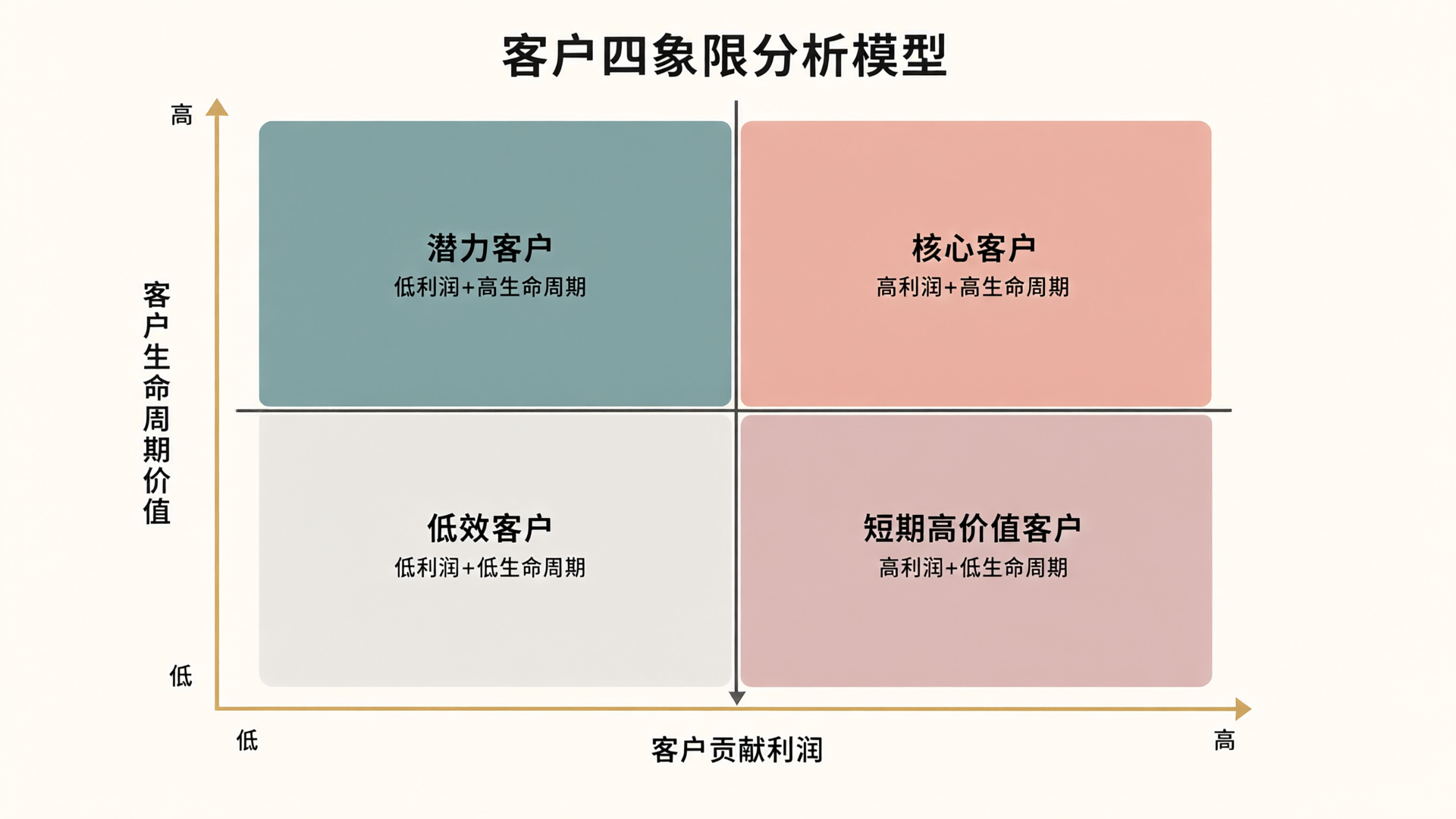
In service businesses, profits often follow a predictable pattern: a small group of customers generates the majority of earnings, while many others contribute little or even drain resources. The key challenge for every service provider is how to identify and focus on high-value customers within limited capacity. The Customer Quadrant Analysis offers a clear framework, and Hongzhu Management Accounting Tools make this methodology easy to implement.
Two core dimensions of customer quadrant analysis
Quadrant analysis fundamentally segments customers by cross-referencing two key dimensions. For service-based enterprises, the most commonly used dimensions are customer contribution to profit and customer lifetime value.
Using these two dimensions as axes, all customers are divided into four quadrants: Quadrant I contains "Core Customers" with high profit and long lifecycle; Quadrant II includes "Short-Term High-Value Customers" with high profit but short lifecycle; Quadrant III consists of "Inefficient Customers" with low profit and short lifecycle; and Quadrant IV comprises "Potential Customers" with low profit but long lifecycle.
The value of this classification lies in shifting enterprises from a broad "customer count" mindset to precise "customer quality" operations. For a beauty salon with 500 customers, if just 50 core customers generate 70% of the profit, business decisions should focus on serving these 50 key clients—not blindly chasing growth in total customer numbers.
Unique Characteristics of Service Industry Customer Analysis
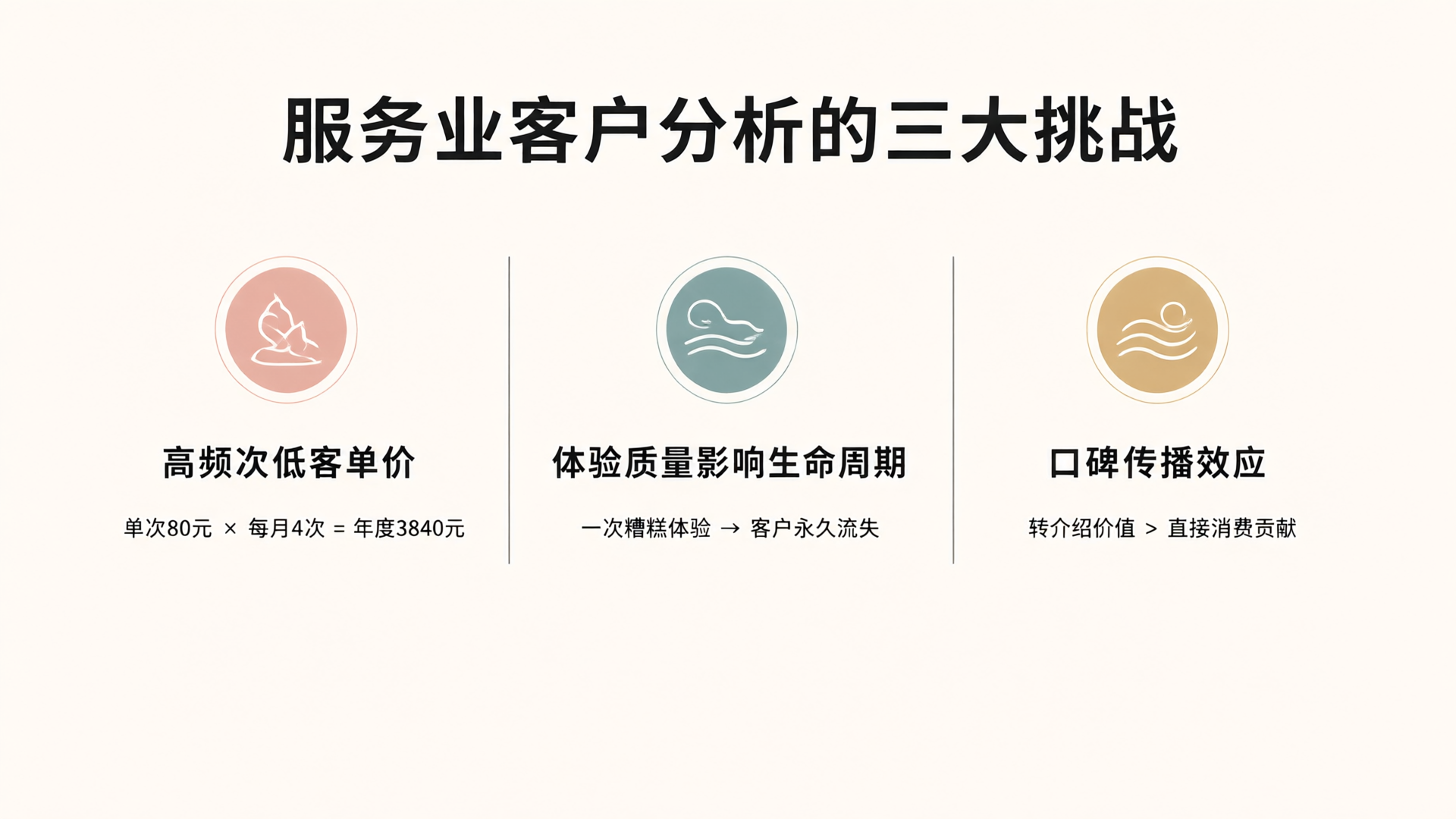
Unlike manufacturing and e-commerce, evaluating customer value in the service industry faces three unique challenges.
First, service consumption is characterized by high frequency and low average order value. A single transaction rarely reveals the full picture of a customer. For instance, a restaurant patron might visit 4 times per month with an average spend of 80 yuan, totaling 3840 yuan annually. While this data may seem insignificant on a per-transaction basis, it clearly identifies them as a high-value customer when viewed cumulatively.
Second, the customer lifecycle in the service industry is highly sensitive to experience quality. A single poor service experience can lead to permanent customer churn, while consistent, high-quality service builds strong loyalty. Customer lifetime value depends not only on spending power but also on the consistency of service quality.
Third, word-of-mouth from service industry clients is highly impactful. A high-value client's referral value often exceeds their direct spending contribution. This is especially evident in beauty, fitness, and education sectors.
These factors mean that service firms cannot simply apply the manufacturing model of "order value × repurchase rate" to quadrant analysis; they must incorporate more comprehensive evaluation metrics.
Red Bamboo Management Accounting Tool: Operation Demo
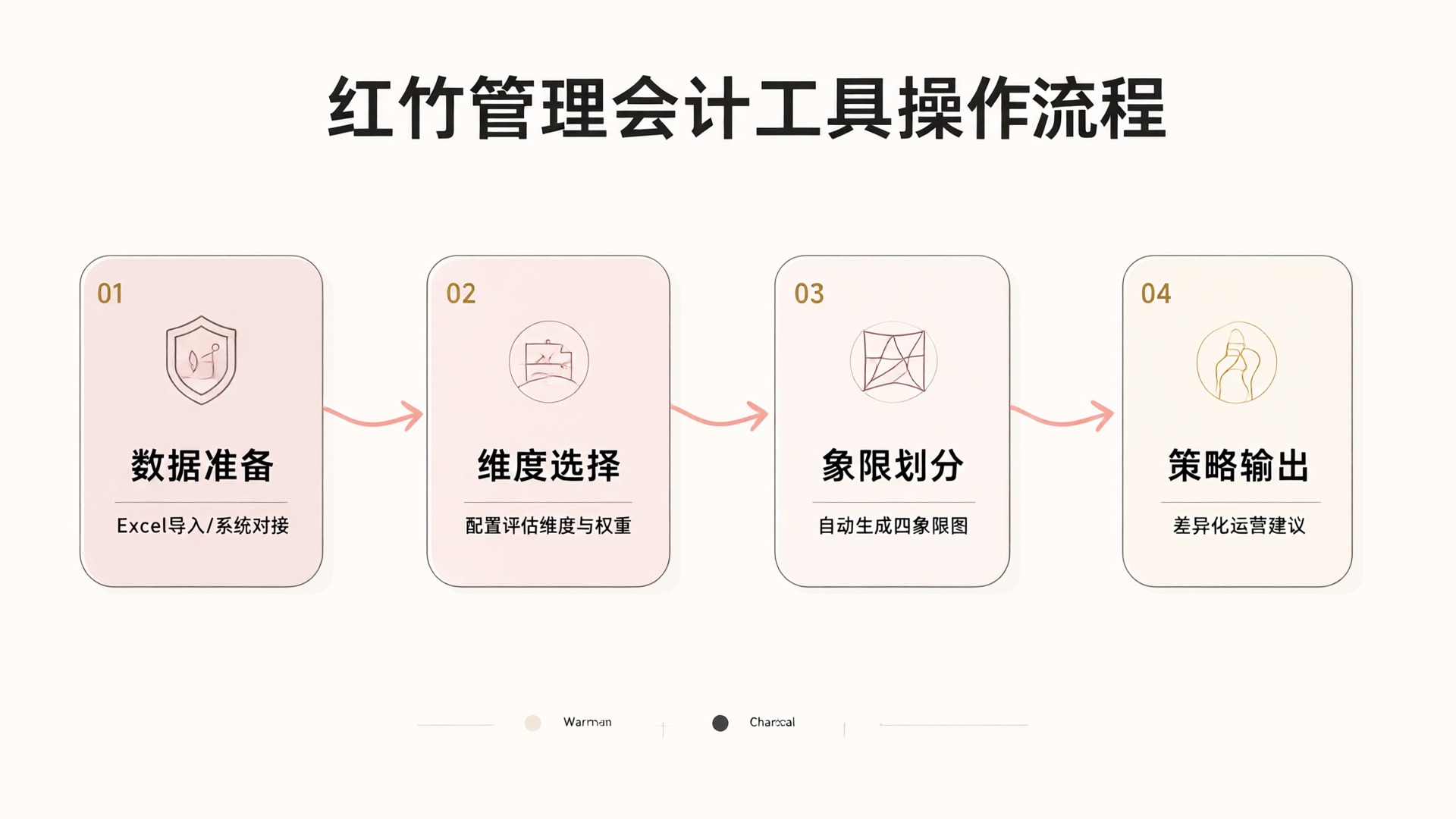
In Hongzhu Management Accounting Tools, we transform the above methodology into an actionable digital operating process.
The first step is data preparation. Businesses must organize their customers' core transactional data, including total spend, purchase frequency, recency of last purchase, and customer acquisition cost. Hongzhu supports bulk Excel import and direct integration with leading financial systems to establish a unified business-and-finance data foundation.
Step 2: Dimension Selection and Weight Setting. The tool includes pre-configured dimension combinations tailored for the service industry, allowing businesses to choose based on their specific needs. For example, a chain beauty salon might select "Cumulative Contribution Profit" and "Purchase Frequency × Estimated Lifetime Value" as its two dimensions; the system will then automatically calculate each customer's score across both metrics.
Step 3: Quadrant Segmentation and Visualization. The system automatically assigns customers to four quadrants based on defined thresholds and displays them in a scatter plot. Each point represents a customer, and its size can map a third metric (e.g., number of referrals), enabling a two-dimensional view of three-dimensional data.
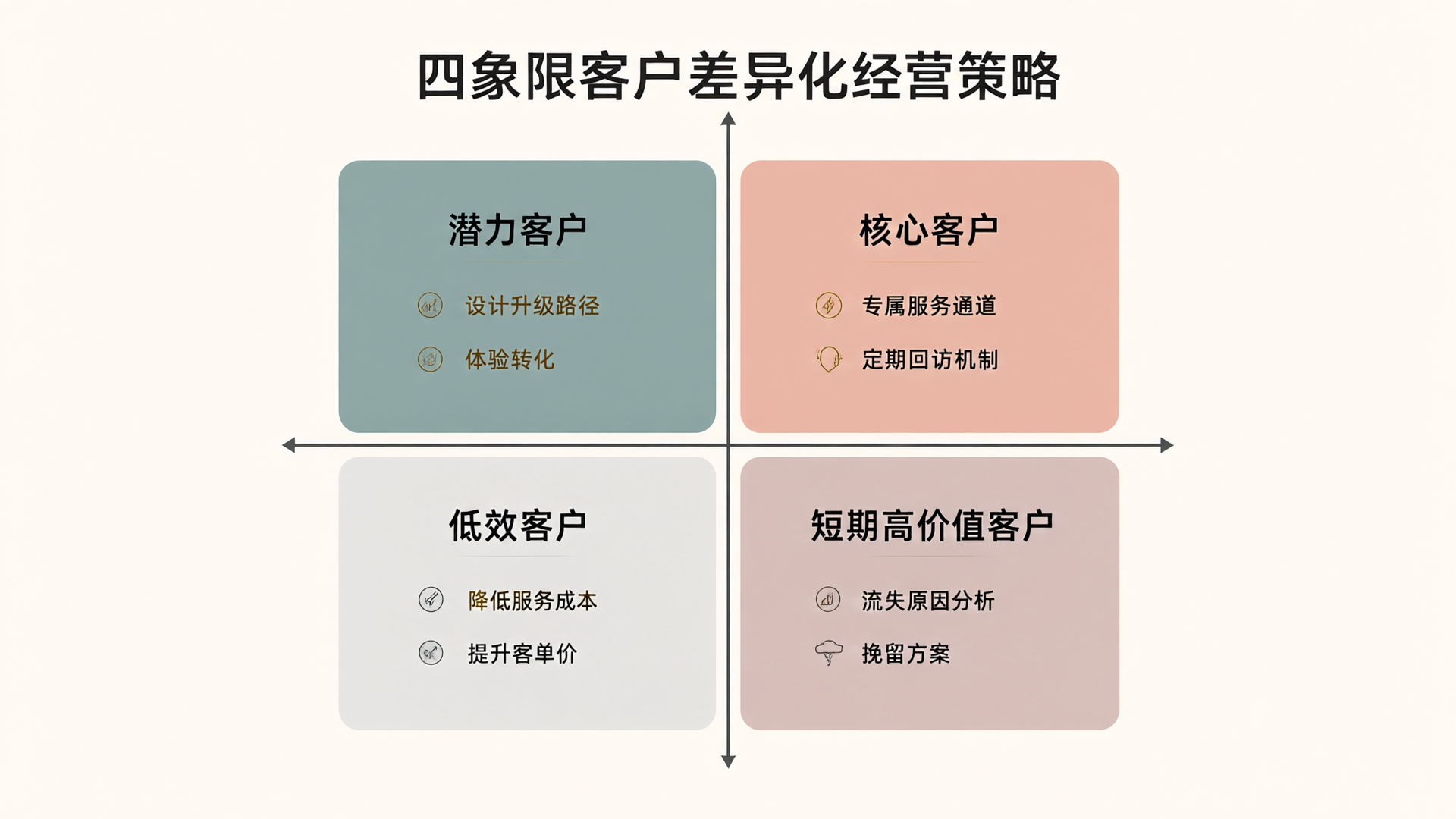
Step 4: Interpret Results and Generate Strategies. The tool automatically generates tailored operational recommendations based on the customer's quadrant. Core customers receive dedicated service and in-depth retention strategies; high-value short-term customers require churn analysis and win-back plans; low-efficiency customers are candidates for service downgrades or price adjustments; and potential customers are assigned upgrade pathways.
From Insights to Business Decisions
The ultimate goal of quadrant analysis is not to create a visually appealing chart, but to drive optimization of business decisions.
For key clients, service enterprises should establish dedicated service channels and regular follow-up mechanisms. A management consulting firm assigned a dedicated project manager to its key clients, providing quarterly business analysis reports. As a result, the client renewal rate increased from 65% to 89%.
For short-term, high-value customers, it's critical to analyze why their spending has stalled. Is it due to competitors' lower prices, or issues with service quality? Hongzhu Tools' churn prediction feature automatically alerts your team when a customer's purchase frequency drops, enabling timely intervention.
For low-efficiency customers, the core strategy is to reduce service costs or increase average order value. Standardize service processes to lower delivery costs, or design value-added packages to drive upmarket consumption.
For potential customers, the key is to design a clear upgrade path. A fitness studio offered 3 free personal training sessions to prospects, with 40% converting to annual members after the trial.
Drive customer engagement with data
Customer quadrant analysis is not a one-time project but an ongoing operational habit. Customer value evolves over time, with clients migrating across quadrants: today's high-potential customers may become tomorrow's core clients, while current core clients can slip into low-efficiency segments.
Hongzhu Management Accounting Tools upgrades this analysis method from manual calculations to a systematic, automated process, enabling service-based businesses to focus on strategy formulation and customer engagement. Currently, Hongzhu offers a free Customer Quadrant Analysis tool that companies can use directly online. By scheduling a consultation, you'll also receive the "Owner's Value Performance Report," helping you gain clarity on your true business status and identify profit growth opportunities. When customer data is reflected in real time on the quadrant chart, your operational decisions have a reliable anchor.